Walk into a supplement store or browse protein powders online, and you will quickly encounter two terms: whey protein isolate and whey protein concentrate. Both come from whey, both provide complete protein, and both can support muscle recovery and growth. Yet they are not exactly the same.
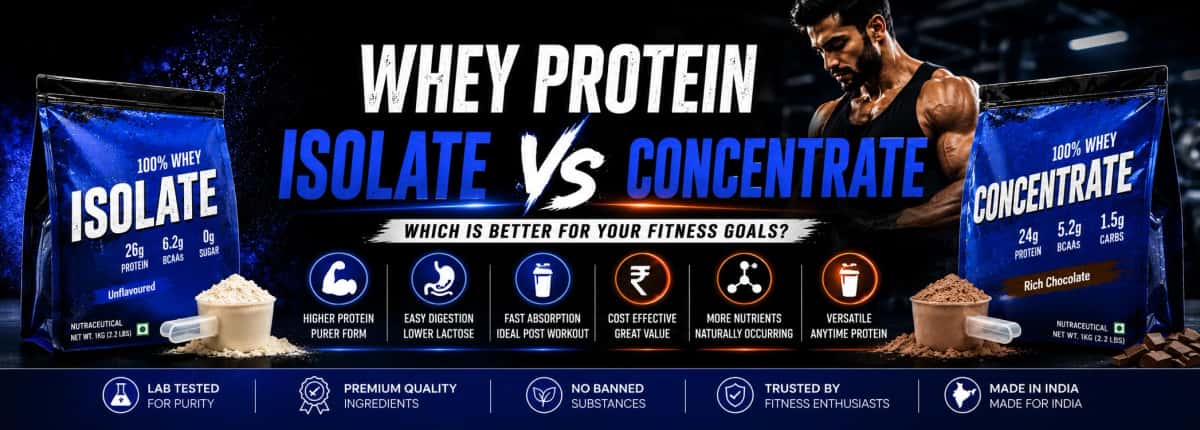
The main difference comes down to processing and the resulting nutritional composition. Whey protein isolate undergoes additional filtration to remove more fat, carbohydrates and lactose, resulting in a higher concentration of protein. Whey protein concentrate retains more of these components and can still provide an effective source of high-quality dietary protein.
So, in the whey protein isolate vs concentrate debate, which one deserves a place in your shaker?
There isn't one universal winner. Someone trying to keep carbohydrates and fats tightly controlled may have different priorities from a beginner simply trying to meet daily protein requirements. Your digestion, overall diet, training goals and the nutritional profile of the actual product matter more than choosing whichever label sounds more premium.
This guide breaks down those differences so you can make a decision based on your fitness goals rather than supplement-industry hype.
Whey Protein Isolate vs Concentrate: Quick Answer
Whey protein isolate generally contains a higher percentage of protein by weight and less lactose, fat and carbohydrates than whey protein concentrate because it undergoes additional filtration. Whey concentrate is less extensively processed and still provides complete, high-quality protein. Both can support muscle growth and recovery when they help you meet your overall protein needs.
The better choice therefore depends on what you want from your protein powder.
| Factor | Whey Protein Isolate | Whey Protein Concentrate |
|---|---|---|
| Processing | More extensively filtered | Less extensively filtered |
| Protein concentration | Generally higher | Generally lower |
| Lactose | Usually lower | Usually higher |
| Fat | Usually lower | Usually higher |
| Carbohydrates | Usually lower | Usually higher |
| Complete protein | Yes | Yes |
| Muscle building | Effective | Effective |
| Cutting/tight macros | Often convenient | Can still fit |
| General protein supplementation | Excellent option | Excellent option |
| Best choice depends on | Diet, digestion, macros and goals | Diet, digestion, macros and goals |
The exact nutrition values can vary considerably between products. Always compare the nutrition and ingredient labels rather than assuming every isolate or every concentrate has identical macros.
What Is Whey Protein Concentrate?
Whey is a milk-derived protein. During dairy processing, whey is separated from other components and then processed and filtered to produce the whey protein ingredients commonly found in sports nutrition products.
Whey protein concentrate (WPC) is produced by filtering whey to increase its protein content while retaining varying amounts of carbohydrates, lactose, fat and other milk-derived components.
The word concentrate does not mean inferior protein.
It remains a complete protein source containing all nine essential amino acids. For someone who digests dairy comfortably and mainly needs a convenient way to increase daily protein intake, a well-formulated whey concentrate can perform that job effectively.
The actual percentage of protein depends on the grade of concentrate and formulation, which is another reason consumers should evaluate the individual nutrition label rather than judging a product solely by the words on the front of the pack.
Who Is Whey Protein Concentrate Best Suited For?
Whey concentrate can make sense for gym-goers, beginners and experienced lifters who tolerate dairy well and want a convenient source of complete protein without specifically requiring the leaner macronutrient profile associated with isolate.
For muscle gain in particular, concentrate shouldn't be dismissed simply because isolate contains a greater proportion of protein by weight. Your total daily protein intake, calorie intake, resistance-training quality and recovery ultimately have a much greater influence on progress.
What Is Whey Protein Isolate?
Whey protein isolate (WPI) starts from the same whey source but undergoes further processing and filtration to remove a greater proportion of non-protein components.
The result is typically a protein ingredient with a higher percentage of protein by weight and lower amounts of lactose, carbohydrates and fat than whey concentrate.
That nutritional profile can make isolate particularly attractive to people who want more protein with fewer accompanying macronutrients, such as someone managing calories closely during a cutting phase.
Its reduced lactose content can also make some isolate products easier to accommodate for people who do not tolerate larger amounts of lactose well. However, lower lactose should not automatically be interpreted as lactose-free, and lactose intolerance is different from a milk allergy.
Who Is Whey Protein Isolate Best Suited For?
Isolate can be particularly useful for people who prioritize a higher protein concentration, want to limit accompanying carbohydrates and fat, are closely managing calories, or prefer a whey product with generally less lactose.
It is also a practical option for athletes and regular gym-goers who simply prefer the nutritional characteristics of isolate.
However, none of those characteristics means that every person who exercises needs whey isolate. If concentrate fits your nutrition, digestion and protein requirements, it can also support your fitness goals.
That distinction is important because choosing a protein supplement should begin with what your body and diet require, not with which form has the more premium-sounding name.
You may read Best Whey Protein Isolate in India.
Whey Protein Isolate vs Concentrate: What Are the Key Differences?
Isolate and concentrate share the same basic origin and both provide high-quality protein. Their differences become clearer after processing.
1. Protein Concentration
This is one of the most important distinctions.
Because whey isolate undergoes additional filtration, a greater proportion of the finished ingredient consists of protein. Whey concentrate retains a greater proportion of other milk components, so its protein concentration is generally lower.
But shoppers should be careful about translating this into:
“Isolate builds more muscle because it has more protein.”
That conclusion misses the bigger picture.
Suppose two people ultimately consume an appropriate amount of high-quality protein throughout the day. One obtains part of it from concentrate and another from isolate. Simply choosing isolate does not automatically guarantee superior muscle growth.
What matters is whether your supplement helps you meet your protein requirements alongside an appropriate diet and training programme.
This is where calculating your overall requirement is more useful than obsessing over the name printed on the tub. Gibbon Nutrition's protein calculator, for example, can be used to estimate daily protein requirements according to individual characteristics and training goals.
2. Carbohydrates and Fat
Further filtration generally leaves whey isolate with less carbohydrate and fat than concentrate.
For many people, the absolute differences per serving may fit comfortably into their daily diet. For others—particularly those tracking calories and macronutrients carefully—the difference may be useful.
This is why context matters.
A bodybuilder preparing for a cutting phase and carefully accounting for daily macros may value the leaner profile of an isolate. Someone trying to gain weight while already eating in a calorie surplus may care far less about a small amount of additional carbohydrate or fat.
Neither situation makes one protein inherently “good” and the other “bad.”
3. Lactose Content
Lactose is another meaningful difference between whey isolate and whey concentrate.
Additional filtration typically removes more lactose from isolate. Whey concentrate generally retains more.
For people who tolerate dairy normally, this difference may not be particularly important. For someone who experiences digestive discomfort from lactose, however, the amount present in a particular protein powder deserves closer attention.
Importantly, whey isolate should not automatically be assumed to contain zero lactose. Check the actual product information if lactose intake matters to you.
And someone with a milk allergy should not treat low-lactose whey as equivalent to a dairy-free protein. Whey itself is derived from milk.
4. Calories
Because isolate generally contains less fat and carbohydrate, it can provide a greater proportion of its calories from protein.
This is one reason isolate is popular among people following calorie-controlled diets.
But don't fall into the trap of thinking:
Isolate = weight loss
Concentrate = weight gain.
Neither statement is accurate.
Body-weight changes depend primarily on the broader relationship between energy intake and expenditure over time. Protein powder is only one component of the diet.
5. Processing and Filtration
The difference between concentrate and isolate begins largely with how whey is processed.
Both undergo filtration. Isolate simply goes through further processing designed to increase the proportion of protein while reducing more of the remaining lactose, fat and carbohydrate.
This has led to another common misconception: less processed must automatically mean healthier.
That is not a useful way to judge sports nutrition.
Processing here serves a functional purpose. What matters is the resulting nutritional composition, ingredient quality, safety, testing and whether the product suits the person's requirements.
Similarly, extra filtration does not magically transform isolate into a muscle-building substance fundamentally different from whey concentrate. Both still provide whey protein and its essential amino acids.
6. Digestion and Individual Tolerance
Two people can consume the same protein powder and have very different experiences.
The amount of lactose, serving size, added ingredients, sweeteners and individual digestive tolerance can all influence how comfortable a protein supplement feels.
Because isolate generally contains less lactose, some people who are sensitive to lactose may find certain isolates easier to accommodate. But this should not be generalized to everyone.
If concentrate works comfortably for you, there is no inherent digestive reason to change simply because someone at the gym says isolate is “cleaner.”
7. Amino Acid Quality
Both whey isolate and whey concentrate are complete proteins, meaning they contain all nine essential amino acids.
Whey is naturally valued in sports nutrition because of its essential amino acid profile, including branched-chain amino acids such as leucine. Leucine plays an important role in signalling muscle protein synthesis, although actual muscle adaptation still depends on adequate protein intake, training and recovery over time.
Because isolate contains a greater percentage of protein by weight, the amount of protein—and consequently amino acids—relative to the same weight of powder can differ.
But when comparing products, look at what the actual serving provides rather than assuming the word “isolate” alone tells you everything.
Gibbon Nutrition's own whey range illustrates why reading beyond the category name matters. Its current Muscle Whey formulation uses whey protein concentrate together with whey protein isolate, while the My Whey formulation shown on its product packaging uses whey protein concentrate as its whey protein source. The products also have different serving-level nutrition profiles. That is exactly why shoppers should compare formulations and labels rather than treating all “whey” products as nutritionally interchangeable.
Whey Protein Isolate vs Concentrate for Muscle Gain
If your main goal is building muscle, here's the answer that matters most:
Both whey protein isolate and whey protein concentrate can support muscle growth.
Resistance training creates the stimulus. Adequate dietary protein supplies amino acids needed for muscle protein synthesis and repair. Sufficient energy, progressive training, sleep and consistency help turn that process into meaningful progress over time.
Choosing isolate does not override those fundamentals.
An isolate can make it easier to obtain a relatively high amount of protein while keeping additional carbohydrates and fats lower. Concentrate can provide the same essential amino acids and can work perfectly well when its overall nutritional profile fits your diet.
So instead of asking only:
“Which type of whey builds more muscle?”
A better set of questions is:
Am I consuming enough protein overall? Does this serving provide a meaningful amount of protein? Does the product fit my calorie and macronutrient requirements? Can I digest it comfortably? Am I training consistently enough to actually use that nutrition effectively?
Once those fundamentals are in place, the difference between isolate and concentrate becomes a matter of nutritional fit rather than a shortcut to faster gains.
Which Is Better for Muscle Recovery?
Muscle recovery is another area where isolate is often marketed as automatically superior to concentrate. In practice, the difference is more nuanced.
After resistance training, muscle protein breakdown and synthesis are part of the body's normal adaptive response. Consuming sufficient high-quality protein provides essential amino acids that support muscle protein synthesis and the repair and adaptation process.
Both whey isolate and whey concentrate can contribute because both provide complete protein with essential amino acids, including leucine.
Whey isolate may provide more protein relative to the same amount of powder because more non-protein components have been removed. But if two suitable products provide comparable amounts of high-quality protein per serving, the practical recovery difference is unlikely to come down simply to whether the label says isolate or concentrate.
Your total daily protein intake, how that protein is distributed across meals, training load, overall calorie intake, hydration and sleep are all part of the recovery equation.
This also means you don't need to panic if you cannot drink a protein shake immediately after your final repetition. Post-workout protein can be useful and convenient, but recovery isn't controlled by a tiny “anabolic window” that suddenly closes if your shake is late.
For most people, consistently meeting protein requirements matters more than obsessing over a few minutes of protein timing.
Whey Isolate vs Concentrate for Weight Loss and Cutting
If you're cutting or trying to reduce body fat while maintaining muscle, whey protein isolate can have a practical advantage—but not because isolate itself burns fat.
The advantage is its protein-to-calorie and macronutrient profile.
Since additional filtration generally removes more carbohydrate and fat, isolate can provide a relatively high proportion of protein while making it easier to keep other macros controlled. This can be useful for someone working within a tightly managed calorie budget.
Imagine two lifters who both need additional protein.
One is in a muscle-gain phase and has plenty of room in the day's calorie intake. The other is several weeks into a cutting phase and tracks nearly every gram of carbohydrate and fat.
The nutritional difference between isolate and concentrate may matter much more to the second person.
However, whey isolate should never be positioned as a weight-loss supplement in itself. Fat loss still requires an appropriate overall energy balance, while resistance training and adequate protein can help support the retention of lean mass during a calorie deficit.
A whey concentrate can therefore still fit into a cutting diet if its calories and macros fit the person's overall nutrition plan.
The correct question isn't:
“Which protein makes me lose weight?”
It is:
“Which protein makes it easier for me to meet my protein target while staying within my nutrition plan?”
For some people, the answer will be isolate. For others, concentrate works perfectly well.
Which Is Better for Bulking?
When the goal changes from losing fat to gaining body mass and muscle, the decision changes again.
Bulking generally involves consuming sufficient protein alongside enough total energy to support training and gradual weight gain. In that context, the slightly higher carbohydrate or fat content commonly found in whey concentrate may not be a disadvantage at all.
Both concentrate and isolate can fit into a muscle-building diet.
If you already obtain plenty of calories from food and simply want a leaner protein source, isolate can still make sense. If you tolerate concentrate well and its nutritional profile fits your calorie surplus, there is no compelling reason to avoid it.
More importantly, whey protein and mass gainers serve different nutritional purposes.
A whey protein supplement primarily helps increase protein intake. A mass gainer is generally formulated to provide substantially more overall energy, often through a combination of protein and carbohydrates.
Someone struggling to consume enough calories for weight gain therefore has a different problem from someone who merely needs another convenient protein serving.
We'll explore that distinction separately in our upcoming guide on Mass Gainer vs Whey Protein, because treating the two as interchangeable can lead beginners to choose a supplement that doesn't actually match their goal.
Whey Isolate vs Concentrate for Beginners
If you have recently joined a gym, the sheer number of protein products can make isolate seem like the “advanced” version of whey and concentrate the “beginner” version.
That is not how they work.
There is no rule that beginners should start with concentrate and graduate to isolate.
Your training experience does not determine which form your body is allowed to use. The decision should instead depend on your diet, protein requirements, digestion, goals and the nutritional profile you prefer.
A beginner who tolerates dairy comfortably and simply needs help meeting daily protein requirements may find whey concentrate entirely suitable.
Another beginner may prefer isolate because they want lower lactose or are carefully managing carbohydrate and fat intake.
And some beginners may not need a protein supplement at all if their normal diet already provides sufficient high-quality protein.
This is an important distinction. A protein powder is primarily a convenient dietary tool, not the foundation of a fitness programme.
Before buying one, understand approximately how much protein you already consume through foods such as milk, curd, paneer, eggs, fish, poultry, meat, soy, legumes and other protein-rich foods. The gap between your intake and requirements gives you a much better reason for choosing a supplement than simply copying what someone else at the gym uses.
What About Lactose and Digestion?
Digestibility is one of the strongest legitimate reasons someone might compare whey protein isolate vs concentrate.
Because whey concentrate retains more milk-derived components, it generally contains more lactose than isolate. Additional filtration removes much of this lactose from whey isolate.
For someone with normal lactose digestion, that difference may go completely unnoticed.
For someone with lactose intolerance, it can matter.
Lactose intolerance occurs when the body has difficulty digesting lactose, the natural sugar found in milk. Depending on the individual and the amount consumed, symptoms can include bloating, gas, abdominal discomfort and changes in bowel habits.
However, three distinctions are worth remembering.
First, lower lactose does not necessarily mean lactose-free. The amount varies between ingredients and finished products, so the product label should always be checked.
Second, individual tolerance varies. Someone may tolerate a particular serving of whey without difficulty while another person reacts differently.
Third, lactose intolerance and milk allergy are not the same thing. Whey is a milk-derived protein. Removing much of the lactose does not make whey protein suitable for someone simply because their problem involves milk proteins rather than lactose.
If you consistently experience digestive symptoms after consuming dairy or protein supplements, guessing which ingredient is responsible is less useful than discussing persistent concerns with an appropriately qualified healthcare professional.
Does Whey Isolate Absorb Faster Than Concentrate?
You'll often hear that whey isolate is “faster absorbing” and therefore better immediately after exercise.
There is some logic behind the first part: isolate contains a greater proportion of protein with less fat, carbohydrate and other material, and processing can affect digestion characteristics. But the fitness implication is frequently exaggerated.
Both isolate and concentrate are whey proteins and are generally considered rapidly digested protein sources compared with many whole-food proteins.
The difference does not mean that concentrate suddenly becomes ineffective after training or that isolate reaches your muscles instantly and creates dramatically greater gains.
For the average healthy gym-goer, the practical priorities remain much larger:
adequate daily protein, an appropriate protein serving, overall diet quality, consistent resistance training and sufficient recovery.
This is a useful example of the difference between a measurable nutritional distinction and a meaningful real-world advantage. Not every technical difference between supplements produces a noticeable difference in physique or performance.
How to Choose Between Whey Protein Isolate and Concentrate
Instead of asking which protein wins universally, match the characteristics of each form with the problem you're actually trying to solve.
| If Your Priority Is... | What to Consider |
|---|---|
| Higher protein concentration | Whey isolate generally has the advantage |
| Lower lactose | Isolate generally contains less |
| Lower carbohydrate and fat | Isolate is typically leaner |
| Strict calorie/macronutrient control | Isolate may be more convenient |
| General daily protein supplementation | Either can work |
| Muscle gain | Either can support your goal |
| Post-workout protein | Either can be suitable |
| Comfortable dairy digestion | Either may work |
| Difficulty tolerating lactose | Compare isolate products and actual labels carefully |
| Value relative to your needs | Compare the complete formulation, serving and nutrition panel |
Notice how often the answer is either.
That's intentional.
Protein supplements should solve a nutritional problem. If two different forms both solve yours, there is little value in manufacturing a problem just to justify choosing the more extensively processed option.
Don't Choose Whey Protein Based Only on “Isolate” or “Concentrate”
This may be the most useful lesson in the entire comparison.
Two products labelled “whey protein isolate” can have different serving sizes, formulations, flavours, added ingredients and nutrition profiles. The same applies to concentrates and whey blends.
So turn the pack around.
Look at how much protein you actually receive per serving and how large that serving is. Then examine carbohydrates, total and added sugars, fat, ingredients, allergens and anything else relevant to your dietary requirements.
The ingredient list matters particularly when evaluating a blend. A product can combine whey concentrate and isolate rather than relying exclusively on one form.
Gibbon Nutrition's Muscle Whey is a useful real-world example. Based on the product information shared for this article, the formulation combines whey protein concentrate and whey protein isolate rather than forcing an either/or choice. Its current 37 g serving lists 27 g of protein, 5 g of carbohydrate and 2.11 g of fat.
My Whey provides another useful comparison. Its shared packaging identifies whey protein concentrate as the whey protein ingredient, and its 40 g serving lists 25 g protein, 10.13 g carbohydrate and 2.4 g total fat.
Those figures shouldn't be used to claim that one type of whey is inherently superior—the products have different overall formulations and serving sizes. Instead, they demonstrate exactly why the nutrition panel tells you more than the category name alone.
Authenticity deserves the same attention. A good nutrition panel isn't useful if you cannot trust the product you received. Gibbon Nutrition provides a Product Authenticator through which customers can enter the authentication code supplied with their product.
For a consumer in India's crowded sports-nutrition market, checking what is inside the product and whether the product itself is authentic should both be part of the buying process.
Whey Protein Isolate vs Concentrate: Which One Should You Choose?
After all the technical differences, the final decision is surprisingly straightforward.
Consider whey protein isolate when you specifically value a higher concentration of protein, want to keep accompanying carbohydrates and fats lower, are following tightly controlled macros, or want a whey option that generally contains less lactose.
Consider whey protein concentrate when you digest it comfortably, its nutrition profile fits your diet and your main requirement is simply a convenient source of complete, high-quality protein.
And if your goal is muscle gain or recovery?
Both can work.
Your results won't be decided by a single word on the front of your protein pack. They will be shaped far more by whether you consistently consume enough protein and total nutrition, progressively train, recover adequately and stick with the process long enough for adaptation to occur.
For people specifically looking for a leaner protein format, exploring a suitable whey protein isolate can make sense. But compare the nutrition panel, ingredients, serving size and quality indicators before deciding what deserves a place in your daily routine.
The better protein isn't automatically isolate or concentrate.
It's the one that appropriately fits your body, diet and fitness goal—and that you can use consistently.
Frequently Asked Questions
Is whey protein isolate better than concentrate?
Not universally. Whey isolate generally contains a higher proportion of protein and lower amounts of lactose, carbohydrate and fat because it undergoes additional filtration. Whey concentrate remains a complete, high-quality protein. The better choice depends on your nutrition goals, digestion and overall diet.
Can beginners take whey protein isolate?
Yes. Whey isolate isn't reserved for advanced athletes or bodybuilders. A beginner can use it when additional dietary protein is appropriate and the product suits their individual nutrition needs. Beginners should first understand their overall protein intake rather than assuming a supplement is automatically necessary.
Does whey protein isolate contain lactose?
Whey isolate generally contains less lactose than whey concentrate because additional filtration removes more non-protein components. However, lower lactose does not automatically mean lactose-free. Check the individual product information if lactose intake is important to you.
Which whey protein is better for muscle gain?
Both whey isolate and whey concentrate can support muscle gain because both provide complete protein and essential amino acids. Total protein intake, calorie intake, progressive resistance training and recovery matter more than choosing isolate purely because of its name.
Is whey isolate better for weight loss?
Whey isolate does not directly cause weight loss. Its generally lower carbohydrate and fat content can make it convenient for people controlling calories and macros while trying to maintain adequate protein intake. Fat loss still depends on the overall diet and energy balance.
Can I switch from whey concentrate to whey isolate?
Yes, provided whey protein is appropriate for your diet and you tolerate the new product. People may switch because of macro preferences, lactose considerations or simply because a different formulation better suits their needs.
Is whey protein isolate easier to digest?
It can be for some people, particularly when the lower lactose content addresses an individual's lactose sensitivity. But digestion varies between people and can also be affected by serving size and other ingredients in the finished supplement.