Walk into a supplement store or search for whey protein online, and the number of choices can become confusing very quickly. Whey concentrate, whey isolate, blends, different serving sizes, protein percentages, flavours, sweeteners, testing claims and bold “high protein” labels can all compete for your attention.
The problem is that the front of a protein tub rarely tells the whole story.
A product claiming “25 g protein” may use a much larger serving than another product making a similar claim. A product labelled “isolate” may not necessarily be the right choice for your diet. And a higher protein percentage doesn't automatically mean the product will deliver better results if it doesn't suit your nutritional needs or digestion.
So, how do you choose whey protein intelligently?
Start with your own requirements rather than the marketing on the package. Determine why you need a protein supplement, understand the different types of whey, compare the actual protein and serving information, read the ingredient list, consider digestion and dietary needs, and look for appropriate quality and authenticity information.
This guide walks through that process step by step so you can evaluate a whey protein product more confidently before buying it.
How to Choose Whey Protein: The Quick Answer
To choose a whey protein, first determine whether you actually need additional protein and what you want the supplement to achieve. Then compare the whey type, serving size, protein per serving, protein concentration, ingredient list, carbohydrates and fat, digestion and lactose considerations, quality information and product authenticity. The right whey protein is the one that fits your nutritional requirements, fitness goal and individual tolerance.
There is no single whey protein that is automatically best for everyone.
A beginner who simply needs a convenient way to increase daily protein intake may have different requirements from an experienced lifter managing calories closely during a cutting phase. Similarly, someone who tolerates dairy comfortably may have different priorities from someone who is sensitive to lactose.
That is why choosing whey should be a decision-making process, not a popularity contest.
First, Ask Yourself: Do You Actually Need Whey Protein?
Before comparing brands, flavours or protein percentages, answer the most important question:
Why are you buying whey protein in the first place?
Whey protein is primarily a convenient way to increase protein intake. It isn't a substitute for a balanced diet, and joining a gym doesn't automatically mean you need a protein powder.
Your normal meals can provide protein through foods such as dairy products, eggs, meat, fish, poultry, soy, legumes and other protein-rich foods. A supplement becomes useful when convenience or your eating pattern makes it difficult to consistently meet your protein requirements through food alone.
This distinction matters because more protein isn't automatically better. Sports-nutrition guidance recognises protein as important for building, maintaining and repairing muscle, while also noting that protein supplements can be useful when dietary intake doesn't adequately meet needs.
So before buying a tub, consider:
How much protein am I already getting from my food?
What is my training and fitness goal?
Do I regularly fall short of my protein target?
Would a convenient protein shake make my diet easier to follow?
If the answer to the last question is yes, whey may be a practical addition to your routine.
Choose the Right Type of Whey Protein
Once you've established that whey makes sense for your diet, the next decision is the type of whey protein.
The most common forms you'll encounter are whey protein concentrate, whey protein isolate and blends. Hydrolysed whey is another form that may appear in more specialised formulations.
They all originate from whey, but processing changes their nutritional characteristics.
Whey Protein Concentrate
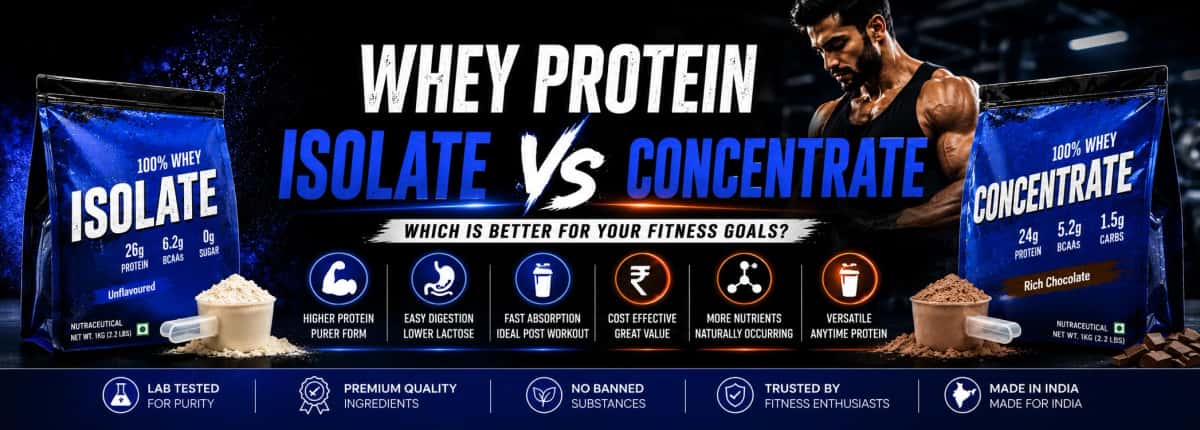
Whey protein concentrate (WPC) undergoes filtration to increase its protein content while retaining varying amounts of lactose, carbohydrates, fat and other milk-derived components.
It can be a practical option for people who tolerate dairy comfortably and simply want a convenient source of complete protein.
Concentrate should not be dismissed as an inferior form of whey. The more useful question is whether its nutritional profile fits your diet.
Whey Protein Isolate
Whey protein isolate (WPI) undergoes additional processing to remove a greater proportion of non-protein components.
As a result, isolate generally provides a higher proportion of protein by weight and lower amounts of lactose, carbohydrates and fat compared with concentrate.
That can make it attractive to people who want a more protein-dense option or are closely managing their calorie and macronutrient intake.
However, isolate isn't automatically necessary for every person.
Our earlier guide on whey protein isolate vs concentrate explores these differences in greater detail.
Whey Protein Blends
Some products combine different forms of whey, such as concentrate and isolate.
A blend isn't inherently better or worse. What matters is understanding what the blend actually contains and whether its nutrition profile fits your needs.
Don't assume that a product is exclusively isolate simply because “whey isolate” appears prominently on the front of the packaging. The ingredient list and nutrition panel provide more useful information.
Hydrolysed Whey Protein
Hydrolysed whey has been processed to break some of the protein into smaller peptides.
It can be used in specialised sports-nutrition formulations, but “hydrolysed” shouldn't automatically be interpreted as “better.”
For most consumers, the decision between concentrate, isolate or another formulation should begin with nutrition, tolerance, goals and overall diet, rather than choosing the most technically processed option available.
Check the Serving Size Before Looking at the Protein Number
This is one of the easiest ways to misread a whey protein label.
Suppose Product A says:
25 g protein per serving
and Product B says:
24 g protein per serving
At first glance, Product A appears to provide more protein.
But what if Product A defines one serving as 40 g, while Product B defines one serving as 30 g?
The headline protein numbers suddenly tell a different story.
This is why you should always look at protein per serving alongside serving size.
A simple way to estimate protein concentration by weight is:
Protein concentration (%) = Protein per serving ÷ Serving size × 100
For example, if a 30 g serving provides 24 g of protein:
24 ÷ 30 × 100 = 80%
That doesn't mean an 80% protein product is automatically better than every product below or above that number. Different whey types and formulations naturally have different compositions.
The calculation is useful because it prevents you from comparing products based solely on a large number printed on the front of the pack.
Current Indian label guidance and buying guides increasingly emphasise checking both per-serving and per-100 g information when comparing protein products.
The practical rule is simple:
Never compare the protein number without checking the serving size that produced it.
Check How Much Protein You Actually Get
Once you've established the serving size, look at the actual protein provided.
A whey protein product can be evaluated from two different perspectives:
How much protein does one serving provide?
and
What proportion of that serving is protein?
Both are useful.
For example, someone who wants a convenient post-workout protein serving may care about how many grams of protein they receive from one scoop. Someone comparing multiple products may also want to understand protein density.
But neither number should be viewed in isolation from the person's overall diet.
If you're already getting enough protein through meals, adding multiple large servings of whey simply because the product contains a high amount of protein isn't necessarily going to improve your results proportionally.
Whey works best as a tool for filling a dietary gap.
This is also where an individualised protein calculation becomes more useful than copying another gym-goer's routine. Your protein requirement depends on factors such as body size, activity, training and overall goals.
Gibbon's Protein Calculator can help turn that broader question into an individual estimate before you decide how much supplemental protein you actually need.
Read the Ingredient List, Not Just the Front Label
The front of the pack is designed to attract attention.
The ingredient list is where you find out what you're actually consuming.
Look for the primary protein source and understand whether the product contains a single whey source or a blend. Then look at the other ingredients used for flavour, sweetness, texture, stability and formulation.
This doesn't mean every unfamiliar ingredient is a “bad ingredient.”
Food and sports-nutrition products often require ingredients that improve taste, texture, solubility or shelf stability. The useful question is whether you understand what is in the product and why it is there, and whether the overall formulation suits you.
Be particularly cautious about products that make impressive claims while providing little clarity about their actual composition.
A transparent label should make it reasonably straightforward to identify:
- the protein source;
- serving size;
- protein content;
- other macronutrients;
- ingredient information;
- relevant allergen information; and
- manufacturer/product details required for the applicable market.
In India, food and health-supplement products operate within the regulatory framework established by the Food Safety and Standards Authority of India (FSSAI), including regulations covering health supplements and nutraceuticals and separate packaging and labelling requirements.
Regulatory compliance is important, but remember:
Regulatory compliance is not the same thing as a guarantee that a product is the best nutritional choice for you.
It is one part of the evaluation.
Look at Carbohydrates, Fat and Sugar
Protein may be the reason you're buying whey, but it isn't the only number worth reading.
Check the carbohydrate, fat and sugar values on the nutrition panel as well.
This becomes particularly important when your broader diet has a specific calorie or macronutrient target.
For example, someone trying to maintain a calorie-controlled diet may prefer a protein product with a relatively lean nutritional profile. Another person with a higher calorie requirement may have considerably more flexibility.
There is therefore no universal rule such as:
“All whey should contain almost no carbohydrates.”
The product should make sense within your diet.
The same principle applies to sugar.
Rather than judging a product simply because it contains a particular sweetener or flavouring ingredient, look at the complete nutrition panel and ingredient list and decide whether the formulation fits your preferences and requirements.
This is one reason comparing products based on the entire serving is more useful than focusing on one isolated number.
Check the Amino Acid Profile
Whey is valued in sports nutrition not only because it contains protein, but because it is a complete protein source containing all essential amino acids.
Essential amino acids are amino acids that your body cannot make in sufficient quantities and therefore needs to obtain from food.
Whey naturally provides them, including the branched-chain amino acids commonly referred to as BCAAs.
Leucine is another amino acid frequently discussed in relation to muscle protein synthesis.
However, don't let amino-acid marketing distract you from the bigger picture.
A whey protein product doesn't become automatically superior simply because its packaging prominently displays BCAA or leucine numbers. The overall protein quality, amount consumed, total daily protein intake and broader nutrition and training programme matter.
For most consumers, the first priority should be:
How much high-quality protein am I getting?
Then consider the broader formulation.
This prevents the common mistake of buying a product because one highlighted amino acid number looks impressive while ignoring serving size and the rest of the nutrition panel.
Consider Digestion and Lactose Tolerance
A protein powder can look perfect on paper and still be a poor choice if you consistently don't tolerate it well.
Whey comes from milk, and different whey products can contain different amounts of lactose depending on how they are processed.
Whey concentrate generally retains more lactose than whey isolate, while isolate typically contains less because of additional processing.
That makes the choice particularly relevant for people who are sensitive to lactose.
But don't assume:
“Isolate = lactose-free.”
Lower lactose and zero lactose are not necessarily the same thing.
Your individual response also matters. Digestive discomfort after a protein shake can have several possible contributors, including lactose, serving size or other ingredients in the formulation. Current Indian consumer guidance similarly recommends considering individual digestive tolerance rather than assuming one whey format works identically for everyone.
There is another distinction that should never be overlooked:
Lactose intolerance is not the same as a milk allergy.
Whey is a milk-derived protein. Reducing lactose does not make whey an appropriate alternative for someone who needs to avoid milk proteins because of an allergy.
If you have a diagnosed medical condition, food allergy or persistent digestive symptoms, speak with an appropriately qualified healthcare professional rather than trying to solve the problem by repeatedly switching supplements.
Check the Quality and Testing Information
Once you've evaluated the nutrition panel, look beyond the macros.
Ask what information the manufacturer provides about quality control, testing, manufacturing and product traceability.
In India, applicable food and health-supplement products are subject to FSSAI's regulatory framework. FSSAI maintains regulations covering health supplements and nutraceuticals as well as food packaging and labelling.
But there's an important distinction worth remembering:
An FSSAI licence is not the same thing as independent third-party testing of every aspect of a product.
A licence addresses regulatory requirements; testing claims need to be understood separately.
If a brand states that products are independently or third-party tested, look for clear information explaining what is tested, by whom and under what quality framework, where such information is made available.
This is much more meaningful than simply seeing “lab tested” printed in large letters on a label.
Transparency is the key.
Verify the Product Before You Consume It
The product you researched online and the product you actually receive should be the same genuine product.
This makes authenticity an important part of choosing sports nutrition supplements, particularly when purchasing through third-party sellers or unfamiliar online sources.
Before using a whey protein, pay attention to the packaging, seals, batch or product information, manufacturing and expiry details and any authenticity mechanism provided by the manufacturer.
Gibbon Nutrition provides a Product Authenticator that allows customers to verify eligible products using the authentication information supplied with the product.
That's useful because authenticity shouldn't depend entirely on trusting a product photograph or a seller's description.
The broader principle is worth remembering:
A good nutrition label is only useful when you can trust that the product you're holding is genuine.
For online purchases, the source of the product matters too. Purchasing through the brand's own channels or an appropriately authorised seller can provide an additional layer of confidence.
Don't Choose Whey Protein Based Only on Price
Price naturally influences a buying decision, but it shouldn't be the first or only comparison.
A larger tub isn't automatically better value. Neither is the product with the lowest price per kilogram.
Instead, compare what you're actually receiving.
Look at:
serving size
protein per serving
number of servings
protein concentration
overall nutrition
ingredient formulation
quality and testing information
authenticity mechanisms
This gives you a more meaningful picture of value.
Two products can have similar pack sizes and very different serving sizes. Likewise, two products can provide similar protein per scoop but have different overall formulations.
The better question is not:
“Which tub is cheaper?”
It's:
“What am I getting for the amount I am paying, and does it actually fit my nutritional needs?”
That approach also keeps your decision useful when prices, offers and pack sizes change.
Match the Whey Protein to Your Fitness Goal
Your fitness goal should influence the type and nutritional profile you choose, but it shouldn't override the basics.
For Muscle Gain
If you're trying to build muscle, the priority is obtaining enough total protein while following a suitable resistance-training programme and eating enough overall nutrition to support your goal.
Whey can make reaching your protein intake more convenient.
You don't necessarily need isolate simply because you're trying to gain muscle. A suitable concentrate or blend can also provide complete protein.
For Cutting
If you're reducing body fat while trying to preserve lean mass, you may prefer a whey formulation that gives you substantial protein without adding unnecessary calories.
This is one situation where whey isolate can be particularly convenient because it generally contains less carbohydrate and fat than concentrate.
But remember: whey isolate doesn't cause fat loss.
Your overall diet and energy balance determine whether you lose body fat.
For General Fitness
If you're exercising regularly and simply want a convenient way to increase protein intake, concentrate, isolate or an appropriate blend can all potentially fit.
Prioritise:
protein needs → tolerance → nutrition → formulation → convenience.
For Beginners
Don't assume that beginners need the most advanced or expensive whey available.
Start with the basics.
Understand your protein requirements. Look at your normal diet. Consider digestion and dietary preferences. Then choose a product that solves the gap you've identified.
A beginner who tolerates concentrate comfortably may have no nutritional reason to switch to isolate.
For People Managing Lactose Intake
If lactose is an important consideration, compare whey types and the actual product information carefully.
Isolate generally contains less lactose than concentrate, but reduced lactose shouldn't automatically be interpreted as lactose-free.
Individual tolerance remains important.
Common Mistakes to Avoid When Buying Whey Protein
Choosing whey becomes much easier when you know what not to do.
Choosing the Biggest Protein Number
A large protein number on the front doesn't tell you enough. Always check the serving size behind that number.
Ignoring the Ingredient List
A product's name doesn't reveal everything about its formulation. Read the ingredients.
Assuming Isolate Is Always Better
Isolate has useful nutritional characteristics, but that doesn't mean everyone needs it.
Comparing Products Without Normalising Serving Size
A 25 g protein claim means little without knowing how large the serving is.
Buying Only on Price
Lower price doesn't automatically mean better value.
Ignoring Digestion
Theoretically ideal nutrition is less useful if you consistently struggle to tolerate the product.
Treating FSSAI Compliance as a Quality Ranking
Regulatory compliance is important, but it isn't a ranking system that tells you which whey is best for your individual needs. FSSAI's framework covers applicable food and health-supplement standards, labelling and related requirements.
Forgetting Authenticity
A product should be verifiable and traceable, particularly when buying online or through third-party channels.
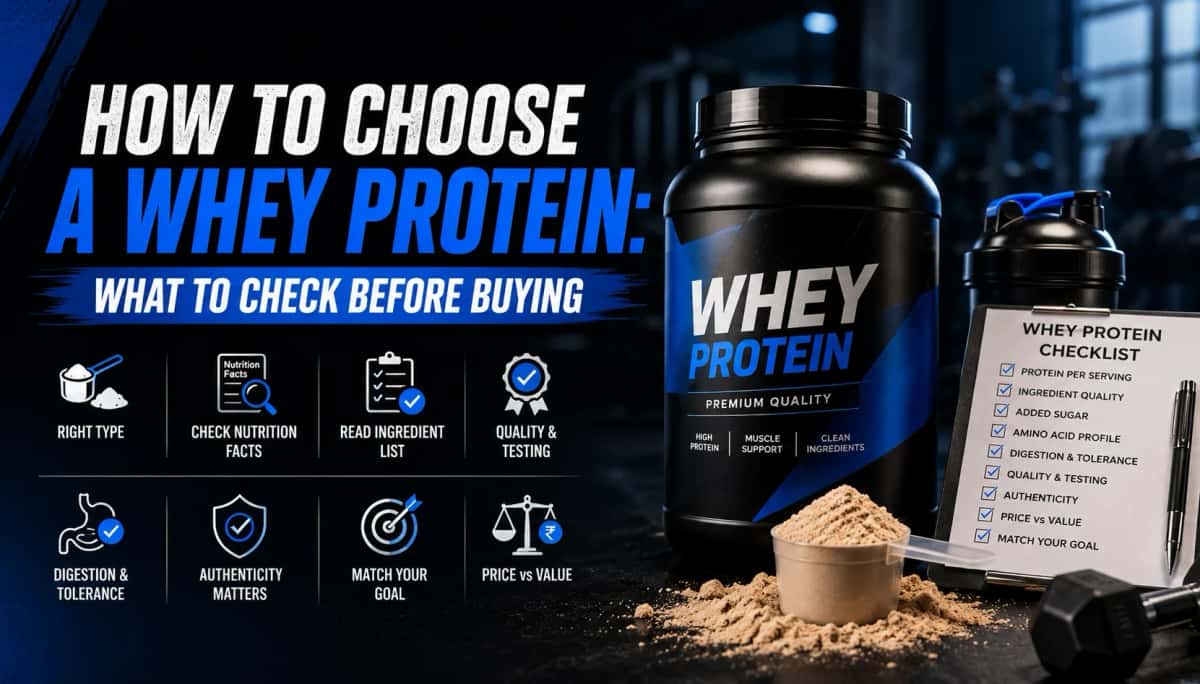
A Simple Whey Protein Buying Checklist
Before you buy, run through this checklist:
| What to Check | What to Ask |
| Your goal | Why am I buying whey? |
| Protein requirement | How much additional protein do I actually need? |
| Whey type | Concentrate, isolate, blend or hydrolysed? |
| Serving size | How many grams is one serving? |
| Protein per serving | How much protein do I actually receive? |
| Protein concentration | What percentage of the serving is protein? |
| Ingredients | What else is included? |
| Carbohydrates and fat | Does the nutrition fit my diet? |
| Digestion | Will I tolerate this formulation? |
| Quality information | What does the manufacturer disclose about quality and testing? |
| Authenticity | Can I verify the product? |
| Value | Am I getting appropriate nutrition for what I'm paying? |
Save this checklist before buying your next whey protein. It can be more useful than any “top 10 whey protein” list because it gives you a framework you can apply to any product.
How to Choose the Right Whey Protein for You
The decision can ultimately be reduced to a few questions.
Do you need additional protein?
If yes, determine what your diet is currently missing.
Do you tolerate dairy and the chosen formulation comfortably?
If yes, compare the available whey options according to their nutrition and your preferences.
Do you want a higher protein concentration with generally lower lactose, carbohydrate and fat?
Whey isolate may be worth considering.
Are you comfortable with the nutritional profile of concentrate?
Then concentrate can be a perfectly reasonable option.
Do you actually need substantially more calories as well as protein?
That's a different nutritional problem. In that situation, a Mass Gainer vs Whey Protein comparison becomes more relevant because a mass gainer is designed to provide considerably more energy alongside protein.
The important thing is to choose based on the gap in your diet, rather than choosing a supplement simply because it is popular.
Final Verdict: What Should You Look for in Whey Protein?
There is no universal “best” whey protein.
The right choice is the one that fits your protein requirements, fitness goal, dietary preferences, digestion, nutritional targets and expectations around quality and authenticity.
Start by asking whether you need a supplement at all. Then choose the whey type that makes sense for your requirements. Check the serving size before comparing protein numbers, examine the complete nutrition panel and ingredient list, consider lactose and digestion, evaluate available quality and testing information, and verify that the product is genuine.
Most importantly, don't let the front of the tub make the decision for you.
Read the label. Understand the numbers. Consider your diet. Then choose.
For consumers looking for a whey option that fits their individual requirements, Gibbon Nutrition's Whey Protein range and Whey Protein Isolate options can be evaluated using the same framework: compare the protein content, serving size, formulation, ingredients and available product information rather than choosing solely on marketing claims.
A good whey protein should make your nutrition strategy easier—not more confusing.
Frequently Asked Questions
What should I look for when buying whey protein?
Start with your protein requirements and fitness goal, then check the whey type, serving size, protein per serving, overall protein concentration, ingredients, carbohydrates, fat, lactose considerations, quality information and product authenticity.
How do I know if a whey protein is good quality?
Look for clear product and ingredient information, a transparent nutrition panel, appropriate regulatory information, manufacturing details and meaningful quality or testing information where provided. Don't judge quality from one number or marketing claim alone.
Is whey isolate better than whey concentrate?
Not for everyone. Whey isolate generally provides a higher proportion of protein with less lactose, carbohydrate and fat, while concentrate retains more of these components. The better option depends on your diet, goals and individual tolerance.
How much protein should whey protein have per serving?
There is no single protein-per-serving number that makes every whey product suitable. Compare the protein amount alongside the serving size and consider how the product contributes to your overall daily protein requirement.
How do I read a whey protein label?
Start with the serving size, then check protein per serving and per 100 g, followed by carbohydrates, fat, sugars and the ingredient list. Also look for relevant manufacturer, regulatory and product-authenticity information.
Is whey protein suitable for beginners?
Whey can be suitable for beginners when additional protein is useful and the individual tolerates the product. Beginners don't automatically need isolate or a high-priced protein. Their first priority should be understanding their diet and protein requirements.
How can I check if whey protein is genuine?
Check the packaging, seals, batch/product details, manufacturing and expiry information and any authenticity-verification mechanism provided by the manufacturer. When available, use the manufacturer's own verification system rather than relying only on a seller's claim.
Should I choose whey protein based on protein percentage?
Protein concentration can be useful when comparing products, but it shouldn't be the only criterion. Also consider protein per serving, serving size, whey type, ingredients, digestion, overall nutrition and whether the product fits your individual needs.