Walk into any gym and you'll hear two supplement names almost immediately: whey protein and mass gainer.
Both are associated with muscle building. Both are available as powders that can be mixed into shakes. And both are often recommended to beginners who want to gain size.
But they aren't interchangeable.
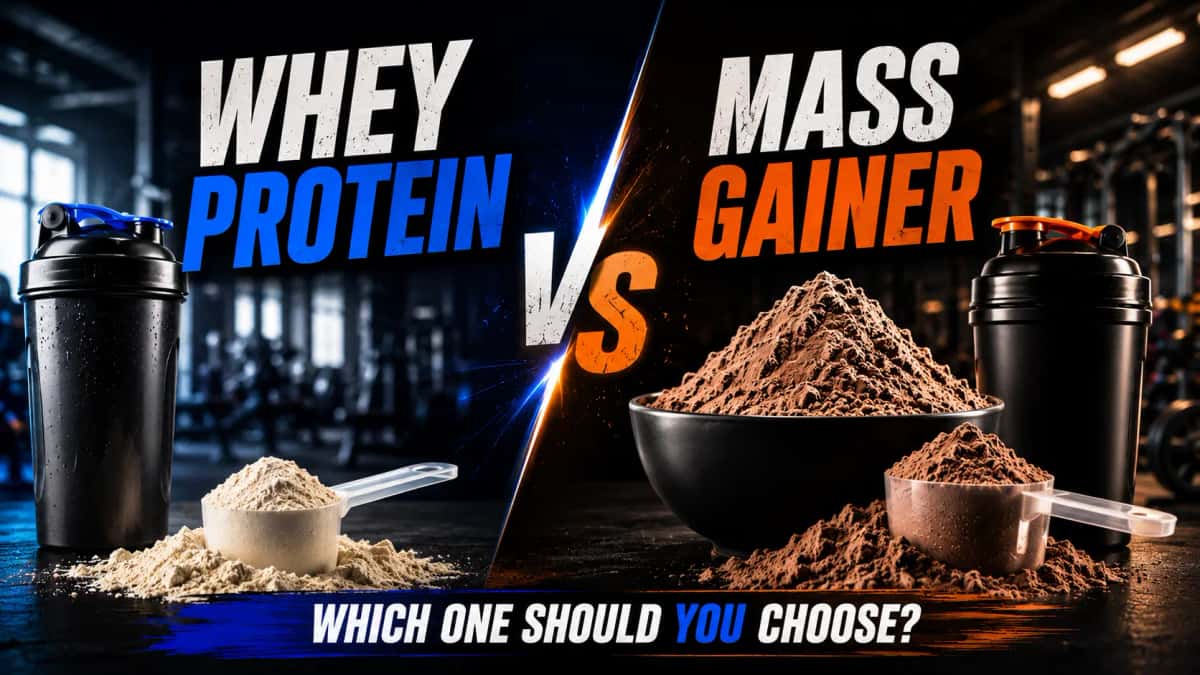
The fundamental difference is surprisingly simple: whey protein is primarily a convenient way to increase protein intake, while a mass gainer is designed to provide substantially more calories along with protein and carbohydrates.
That distinction changes everything.
If you're already eating enough calories but struggling to reach your daily protein requirement, adding a mass gainer may give you far more energy than you actually need. On the other hand, if you're genuinely struggling to eat enough food to maintain a calorie surplus, whey protein alone may not solve the problem.
So, in the mass gainer vs whey protein debate, which one should you choose?
The answer depends less on how experienced you are in the gym and more on what your current diet is missing.
Mass Gainer vs Whey Protein: Quick Answer
Choose whey protein when your main requirement is additional high-quality protein without a large increase in calories. Consider a mass gainer when you are struggling to consume enough total calories for weight gain and also want protein as part of that calorie intake.
Neither supplement is automatically better.
Whey protein is generally more protein-focused, with comparatively fewer calories and carbohydrates per serving. Mass gainers are designed to make consuming a calorie surplus easier, so they typically contain considerably more carbohydrates and calories alongside protein. The exact nutritional profile varies by product, which is why comparing serving-level nutrition is essential.
| Factor | Whey Protein | Mass Gainer |
|---|---|---|
| Primary purpose | Increase protein intake | Increase calorie intake with protein |
| Protein | High relative to serving size | Moderate to high, depending on formula |
| Calories | Usually comparatively low | Usually substantially higher |
| Carbohydrates | Generally lower | Generally higher |
| Best suited to | Meeting protein gaps, muscle support, controlled calories | People struggling to consume enough calories for weight gain |
| Muscle building | Can support muscle growth | Can support muscle growth when paired with adequate training and nutrition |
| Weight gain | Not its primary purpose | Designed to make a calorie surplus easier |
| Cutting | Often easier to fit into controlled calories | Usually less convenient for calorie restriction |
The numbers on that table should never be treated as universal. A product's serving size and formulation can change the comparison considerably.
What Is Whey Protein?
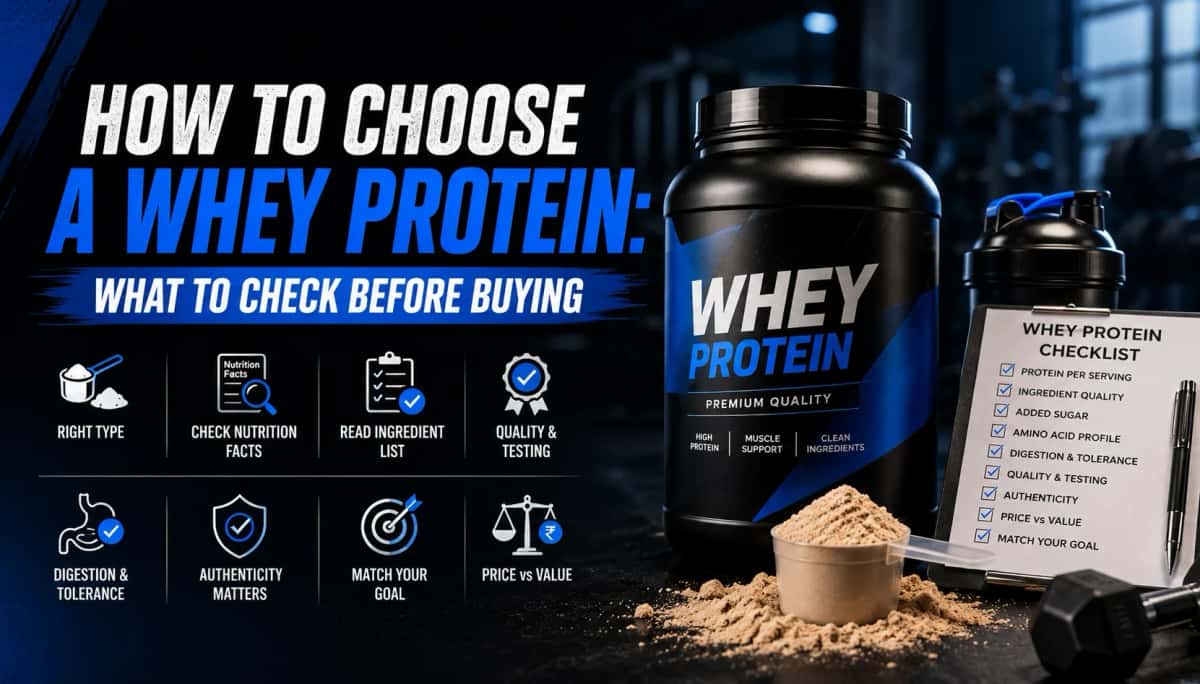
Whey protein is a milk-derived, complete protein source that can help people increase their daily protein intake conveniently.
Whey is obtained during dairy processing and contains all nine essential amino acids. It is widely used in sports nutrition because it provides a concentrated source of protein without requiring a large amount of food.
That makes whey particularly useful when your diet is already providing enough calories but you're finding it difficult to consistently reach your desired protein intake.
For example, imagine someone eats regular meals throughout the day and gets adequate carbohydrates and fats but repeatedly falls short on protein.
Adding a whey shake can help close that protein gap without dramatically increasing total calorie intake.
That's fundamentally different from the problem a mass gainer is designed to solve.
You may read this: Best Whey Protein Isolate in India: A Complete Buyer's Guide
What Is Whey Protein Used For?
Whey protein can be incorporated into a diet to help:
support adequate daily protein intake, provide protein around training, support muscle recovery and contribute to muscle growth when combined with appropriate resistance training and overall nutrition.
It is not a magic muscle-building substance.
If total protein intake is already adequate, adding increasingly large amounts of whey won't automatically translate into proportionally greater muscle growth.
The supplement is useful because it makes adequate protein intake more convenient.
Gibbon Nutrition's current whey range, for example, is positioned around providing protein to support recovery, muscle building and daily protein requirements.
What Is a Mass Gainer?
A mass gainer is a calorie-dense supplement that combines protein with substantial amounts of carbohydrates and, depending on the formulation, other macronutrients.
Its purpose is different from a conventional whey protein powder.
Instead of asking:
“How can I get more protein without many additional calories?”
a mass-gainer user is often asking:
“How can I make it easier to consume enough calories to support weight gain?”
This can be useful for people with a low appetite, demanding training schedules or difficulty consistently eating enough food to establish an appropriate calorie surplus.
But that doesn't mean everyone who wants bigger muscles needs a mass gainer.
If you're already consuming enough calories through normal meals, adding a calorie-dense supplement without accounting for those additional calories can make it easier to overshoot your energy requirements.
Gibbon Nutrition currently offers Mass Gainer in multiple sizes, with its product pages highlighting 24 g protein per serving, lab testing and third-party testing information.
The important point isn't simply that a product contains protein.
It is why the formula contains substantially more total nutrition than a typical whey serving.
The Biggest Difference Between Mass Gainer and Whey Protein
The easiest way to understand the two is to identify the nutritional problem each one is designed to address.
Whey Protein Solves a Protein Gap
Suppose your diet provides enough calories to maintain or gradually change your body weight, but you struggle to consume enough protein from regular food.
A whey shake can provide a convenient protein source without requiring a large meal.
That makes whey particularly useful for people who want to build or preserve lean mass while keeping their overall calorie intake under control.
Mass Gainer Solves a Calorie Gap
Now consider someone who has increased their food intake but still struggles to consume enough calories to support their weight-gain goal.
Eating another large meal isn't always practical.
A mass gainer can make consuming additional calories more convenient by combining carbohydrates and protein in a drinkable format.
This is the distinction many beginner guides miss.
Whey asks: “Do you need more protein?”
Mass gainer asks: “Do you need substantially more calories, with protein included?”
Once you answer those questions honestly, choosing between the two becomes much easier.
Mass Gainer vs Whey Protein for Muscle Gain
This is where the comparison becomes slightly more nuanced.
Both can support muscle growth, but they contribute to different parts of the nutritional equation.
Muscle growth requires an appropriate training stimulus, sufficient protein, adequate energy and recovery. A whey protein supplement can help you meet your protein needs. A mass gainer can help when consuming enough total energy is the bigger challenge.
That means neither supplement can be declared the universal winner for muscle gain.
If You Already Eat Enough Calories
Whey may be the more logical choice if your calorie intake is already sufficient but your protein intake is falling short.
Adding a high-calorie mass gainer in this situation may solve a problem you don't actually have.
If You Struggle to Eat Enough Calories
A mass gainer may make more sense if you've established that your diet isn't providing enough energy to support your weight-gain objective and increasing food intake is consistently difficult.
The key is not the label on the tub.
The key is the gap in your diet.
Mass Gainer vs Whey Protein for Weight Gain
If your primary objective is to increase body weight, a mass gainer has a more direct nutritional role because it is specifically formulated to make a calorie surplus easier to achieve.
But there's an important caveat:
Weight gain is not the same thing as muscle gain.
If you consume substantially more calories than your body needs, the additional weight won't automatically consist entirely of muscle.
Your training, protein intake, rate of weight gain and overall diet all matter.
This is why “take a mass gainer to get big quickly” is a poor strategy.
A better approach is to determine whether you're genuinely struggling to consume enough calories, then use a calorie-dense supplement only if it helps solve that specific problem.
Which Is Better for Lean Muscle Gain?
For someone whose priority is building muscle while keeping overall calorie intake controlled, whey protein is often the more convenient option.
It provides a concentrated protein source without requiring the substantial calorie intake associated with many mass-gainer formulas.
But even here, the word lean shouldn't be misunderstood.
You cannot completely separate muscle gain from changes in body weight or body composition. Building muscle requires an appropriate training and nutrition strategy, and individual results vary.
Whey simply makes it easier to increase protein without automatically adding a large calorie load.
Which Is Better for Beginners?
Beginners often assume that because they are starting resistance training, they need both a mass gainer and whey protein.
They may not.
A new gym-goer should first establish the basics:
- What am I trying to achieve?
- How much am I currently eating?
- Am I getting enough protein?
- Am I struggling to gain weight despite eating consistently?
- Can I meet my nutritional needs through regular food?
If the main issue is insufficient protein, whey may be the more relevant supplement.
If the main issue is consistently failing to consume enough calories for a planned weight-gain phase, a mass gainer may be more appropriate.
And if neither problem exists, you may not need either supplement immediately.
That's an important part of responsible supplement education that often gets lost in “best supplement” articles.
Can You Take Mass Gainer and Whey Protein Together?
Yes, they can be used together when they serve different nutritional purposes.
For example, someone may use whey to help meet a protein target while using a mass gainer at another point in the day to increase total calorie intake.
But combining them doesn't automatically produce better results.
You still need to account for the total protein, calories and other nutrients you're consuming from food + whey + mass gainer + other supplements.
If your diet already provides enough protein and calories, adding both simply because they're available may push your intake beyond what your goal requires.
The question shouldn't be:
“Can I take both?”
It should be:
“Do I have a nutritional reason to use both?”
That distinction can prevent unnecessary supplementation.
Mass Gainer vs Whey Protein: Which One Should You Choose?
The simplest way to decide is to work backwards from your goal.
Choose whey protein if your main problem is protein intake.
Consider a mass gainer if your main problem is calorie intake and you're struggling to consume enough food for your weight-gain goal.
Consider neither if your current diet already meets your nutritional requirements.
And if you are considering both, make sure each one has a clear purpose within your overall diet.
Your supplement should fill a gap—not create one.
For Gibbon Nutrition customers, the same principle applies when comparing the brand's whey and mass-gainer options. The current site separates these products by goal, with whey positioned around protein and muscle support and Mass Gainer under its bulking-oriented category.
Before choosing a product, compare its serving size, protein, carbohydrates, calories, ingredients and recommended usage with what your diet actually needs.
The right choice isn't the supplement with the biggest claims.
It's the one that solves the nutritional problem standing between your current diet and your fitness goal.