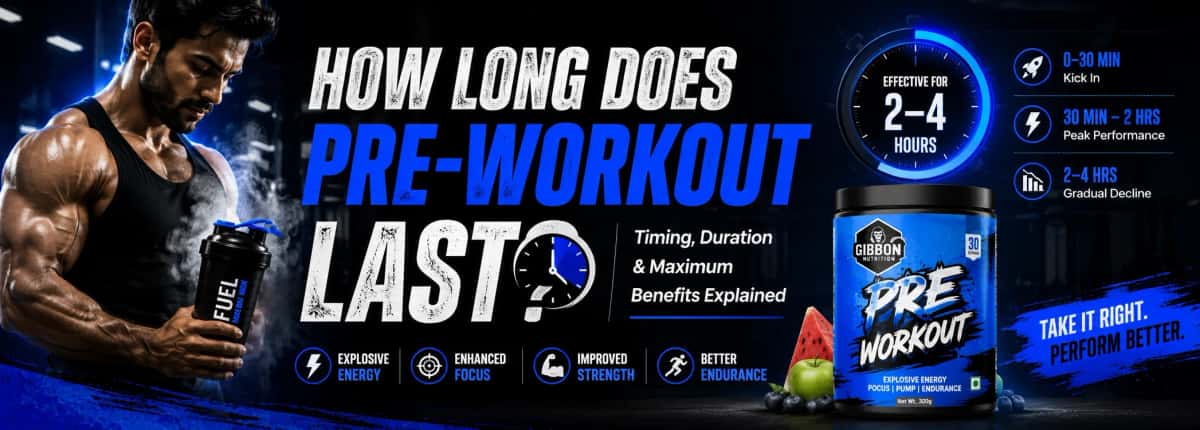
You take your pre-workout, head to the gym and soon feel more alert and ready to train. Your workout finishes an hour later—but does that mean the pre-workout has finished working too?
Not necessarily.
This is where the question “How long does pre-workout last?” becomes more complicated than it initially sounds. A pre-workout isn't one ingredient with one fixed duration. Formulas can contain caffeine and other performance-oriented ingredients, each behaving differently in the body.
More importantly, the period when you feel energized isn't necessarily the same as the period during which an ingredient remains in your system.
That distinction becomes particularly important if you train in the evening. You might no longer feel the strongest stimulation after your workout but still have enough caffeine in your body to interfere with winding down or sleeping normally.
So instead of relying on a universal countdown, it is better to understand when pre-workout starts working, how long noticeable effects may last, which ingredients influence those effects, and what determines your individual response.
The first question that arises before you actually know what is pre-workout?
How Long Does Pre-Workout Last? Quick Answer
The noticeable effects of a stimulant-containing pre-workout commonly last for several hours, but there is no universal duration. How long pre-workout lasts depends on its ingredients and serving size, particularly its caffeine content, as well as your caffeine tolerance, metabolism, food intake and individual sensitivity.
Caffeine deserves particular attention because its biological effects can extend beyond the period when you feel your pre-workout working. This means finishing your workout—or no longer feeling highly stimulated—doesn't necessarily mean the caffeine has left your body.
There are therefore two different questions:
How long can I feel my pre-workout?
and
How long can its ingredients remain active in my body?
They aren't interchangeable.
What Does “Pre-Workout Lasting” Actually Mean?
One reason you'll find different answers online is that the phrase “pre-workout lasts” can describe several different things.
Think of a pre-workout session as a timeline rather than an on/off switch.
First comes the onset. This is the period between consuming the supplement and beginning to notice effects such as increased alertness or, depending on the formulation, sensations associated with particular ingredients.
Then there is the period when those effects feel most noticeable. This is often what gym-goers mean when they say their pre-workout has “kicked in.”
Next comes the perceived workout-effect window. You may continue feeling alert, focused or stimulated throughout part or all of your training session before those sensations gradually decline.
But even after the noticeable stimulation fades, some ingredients can still be present and physiologically active.
That brings us to another concept: half-life.
A substance's half-life describes approximately how long it takes for its amount or concentration in the body to decrease by half. It does not mean the ingredient completely disappears after one half-life.
So if someone says:
“My pre-workout wore off after my workout.”
what they usually mean is:
“I stopped noticing its strongest effects.”
Those statements are biologically quite different.
This distinction becomes especially relevant with caffeine.
How Long Does Pre-Workout Take to Kick In?
There isn't one exact onset time for every pre-workout because different products use different ingredients, amounts and formulations.
For stimulant-containing products, caffeine is often a major contributor to the alertness and energy people associate with a pre-workout. The timing of its effects can vary based on the amount consumed, individual physiology and whether the supplement was taken alongside food.
That is why pre-workout products are generally consumed before training rather than after the workout has already begun.
However, more isn't necessarily better, and taking a supplement earlier doesn't automatically make it more effective. The appropriate approach is to follow the directions provided for the specific product rather than applying another brand's serving or timing instructions to it.
Food can also influence the experience.
Someone taking pre-workout immediately after a substantial meal may perceive its onset differently from someone consuming it under different dietary conditions. Individual caffeine sensitivity creates even more variation.
This explains why one training partner may say:
“I feel it quickly.”
while another using the same product has a different experience.
Neither response provides a universal timer for everyone else.
How Long Do the Effects of Pre-Workout Last?
For many stimulant-containing formulations, noticeable effects can extend across a typical training session and potentially for several hours, but assigning one exact duration to every pre-workout would be misleading.
The formula matters.
A pre-workout built around caffeine produces a different experience from a stimulant-free formulation. And even within caffeinated products, the amount and combination of ingredients can vary significantly.
Your experience can also change depending on:
- the amount of caffeine and other active ingredients consumed;
- your habitual caffeine intake and sensitivity;
- serving size and whether you follow the product directions;
- food consumed around the same time;
- other caffeine sources used during the day;
- individual metabolism and physiology.
This is why statements such as “all pre-workouts last exactly three hours” should be treated cautiously.
There is another important reason.
Different ingredients don't share one common clock.
The stimulation associated with caffeine, the tingling some people experience after beta-alanine, and the role of ingredients such as creatine are fundamentally different. Feeling one sensation disappear doesn't tell you that every ingredient has stopped having a physiological role.
If you are still unsure whether pre-workout really suits you then read Is Pre-Workout Bad for You?
How Long Does Caffeine From Pre-Workout Last?
For stimulant-based pre-workouts, caffeine is usually the ingredient most relevant to the question of duration.
Caffeine acts on the central nervous system and can increase alertness and reduce perceptions of fatigue, which helps explain its widespread use around exercise.
But caffeine doesn't disappear as soon as your workout ends.
Its half-life varies considerably between individuals and circumstances. This means a meaningful proportion of caffeine consumed before training can remain in the body hours later.
Consider why this matters.
Suppose someone takes a caffeinated pre-workout before an evening gym session. They feel highly alert during training. By the time they return home, eat and shower, that obvious “pre-workout feeling” has faded.
They may assume:
The pre-workout is gone.
But the decline in perceived stimulation doesn't establish that the caffeine has been completely eliminated.
That distinction is one reason the timing of caffeinated pre-workout relative to sleep deserves attention—not simply its timing relative to the first exercise.
Caffeine's duration also isn't identical for everybody. Genetics, habitual caffeine consumption, certain medications and other individual factors can influence caffeine metabolism. This is why copying another person's pre-workout timing isn't always sensible.
The practical lesson is simple:
Judge caffeine intake across your entire day, not only during the hour you spend training.
Coffee, tea, energy drinks, caffeinated pre-workout and other sources all contribute to total caffeine exposure.
Pre-Workout Ingredients Don't All “Last” the Same Way
One of the biggest misconceptions about pre-workout supplements is treating the whole scoop as though it were a single active compound.
It isn't.
Depending on the formulation, a pre-workout may contain ingredients intended to support different aspects of exercise performance. Understanding their roles makes it easier to understand why there is no single answer to how long the entire product “works.”
Caffeine
Caffeine is responsible for much of the noticeable stimulation associated with many pre-workouts.
Users may associate it with feeling more awake, alert or prepared to train. Because caffeine can remain in the body beyond the period of strongest perceived stimulation, it is particularly relevant for people who train later in the day.
This is also why increasing caffeine simply because a familiar “buzz” feels weaker is a poor way to judge whether a pre-workout is working.
Perception and physiological presence aren't the same thing.
Beta-Alanine
Beta-alanine introduces another common source of confusion.
Some people experience a temporary tingling or prickling sensation after consuming beta-alanine, known as paraesthesia. Because this sensation can be noticeable, gym-goers sometimes use it as a signal that their pre-workout has “kicked in”—and assume that once the tingling stops, the supplement has stopped working.
That isn't a useful interpretation.
The tingling sensation itself is not the primary performance objective of beta-alanine, nor is its disappearance a countdown timer for the entire pre-workout formula.
In other words:
No tingling does not automatically mean no effect.
And stronger tingling does not automatically mean a better pre-workout.
Citrulline
Citrulline is commonly included in sports-nutrition formulations for reasons very different from caffeine.
It isn't primarily there to create a stimulant “buzz.” Therefore, judging citrulline based on whether you still feel energized several hours later doesn't make much sense.
This highlights an important principle when evaluating any pre-workout:
Different ingredients should be judged according to their intended physiological roles, not according to how strongly you can feel them.
Creatine
Creatine makes this distinction even clearer.
When creatine is included in a pre-workout formula, its usefulness shouldn't be understood as:
“I took creatine 30 minutes ago, so now it has kicked in.”
Creatine's established role in exercise nutrition relates to increasing and maintaining muscle creatine stores through appropriate ongoing intake. Its benefits aren't dependent on creating an immediate stimulant sensation during that particular workout.
This means asking “How many hours does the creatine in my pre-workout last?” misses how creatine supplementation actually works.
And it reinforces the central message of this guide:
A pre-workout formula can contain several ingredients operating through different mechanisms and timescales. There is no single biological stopwatch for the entire scoop.
What Determines How Long Pre-Workout Lasts?
Two people can take the same pre-workout and experience it differently. One may notice the effects throughout an entire training session, while another may feel the strongest stimulation for a shorter or longer period.
That variation is normal because pre-workout duration depends on both the formulation and the person taking it.
Caffeine Content
For stimulant-based pre-workouts, caffeine content is one of the biggest factors affecting how long noticeable stimulation may persist.
However, a higher caffeine amount should not automatically be interpreted as a better pre-workout. More caffeine can also increase the likelihood of unwanted effects, particularly among caffeine-sensitive users.
This is why checking the actual caffeine amount per serving matters more than judging a product by claims such as “extreme energy.”
It also matters whether you use a full serving. With products that specify different serving options, consumers should follow the directions on the individual label rather than estimating their own amount.
Your Caffeine Tolerance
Someone who regularly consumes coffee, tea, energy drinks or caffeinated supplements may perceive caffeine differently from someone who rarely consumes it.
With repeated caffeine consumption, tolerance to some of its effects can develop. As a result, a familiar serving may eventually feel less noticeable.
That does not mean the sensible response is to continually increase the amount.
A fading “buzz” isn't an accurate measurement of whether every ingredient in your pre-workout remains useful. Increasing servings purely to recreate stronger stimulation can unnecessarily increase total caffeine exposure.
Individual Metabolism
Caffeine metabolism varies considerably among individuals.
Genetic differences can influence how quickly caffeine is metabolised. Age, certain medications, pregnancy and other physiological factors can also alter caffeine clearance.
Consequently, one person's experience cannot reliably predict yours.
This is particularly important when someone recommends:
“Take it at this exact time because that's what works for me.”
Their training schedule may be worth considering, but their caffeine metabolism isn't transferable.
Food Intake
What and when you eat can influence how quickly you perceive the effects of a pre-workout.
Taking a supplement around a substantial meal may create a different experience from consuming it under other conditions. This doesn't mean training fasted is automatically better or that you should avoid eating simply to make a pre-workout feel stronger.
Your pre-training nutrition needs to support the workout as a whole.
Other Sources of Caffeine
Pre-workout shouldn't be evaluated in isolation.
If you've already consumed several cups of coffee, tea, an energy drink or another caffeine-containing product, your pre-workout adds to that day's total intake.
This is particularly relevant when judging both how long stimulation lasts and how late in the day caffeine may affect you.
Does Pre-Workout Last Longer on an Empty Stomach?
Taking pre-workout on an empty stomach can change how quickly some people perceive its effects, but it doesn't provide a universal method for making a supplement “work better.”
Food can affect the rate at which caffeine reaches peak concentrations in the blood, so consuming a caffeinated pre-workout around a meal may alter the timing of the experience.
But faster or more noticeable isn't necessarily better.
Someone training after several hours without food may also need to think about energy availability, hydration and the demands of the upcoming workout. Pre-workout supplements are not substitutes for appropriate nutrition.
If the product label provides specific directions about how and when to consume it, those directions should take priority over gym-floor tricks intended to intensify the sensation.
How Long Does Pre-Workout Stay in Your System?
This question is slightly different from how long does pre-workout last?
There isn't one scientifically meaningful elimination time for “pre-workout” because pre-workout is a mixture of ingredients, not a single compound.
Caffeine has one metabolic profile. Beta-alanine behaves differently. Citrulline has another role. Creatine supplementation operates on a completely different timescale.
So claims such as:
“Pre-workout completely leaves your system after X hours”
oversimplify what is happening.
For stimulant-containing formulas, caffeine is usually the most relevant ingredient when someone is concerned about lingering effects.
Research commonly places caffeine's average half-life in healthy adults at roughly several hours, often around five hours, although there can be substantial individual variation.
A half-life of approximately five hours does not mean caffeine disappears after five hours.
For a simplified illustration, if someone consumed 200 mg of caffeine and their caffeine half-life happened to be five hours, roughly half—about 100 mg—could remain after one half-life. After another five hours, the amount would decrease further.
Real human caffeine metabolism is more complicated than this simplified calculation, but the example demonstrates why:
“I don't feel my pre-workout anymore” does not mean “there is no caffeine left in my body.”
Can Pre-Workout Affect Sleep Hours Later?
Yes, particularly when the pre-workout contains caffeine and is consumed relatively close to bedtime.
This may be one of the most important practical considerations for evening gym-goers.
Caffeine promotes alertness partly by interfering with the effects of adenosine, a signalling molecule involved in the build-up of sleep pressure. Because caffeine can remain in the body for hours, consuming it late in the day may affect sleep even after the obvious feeling of stimulation has subsided.
That matters because training performance and recovery aren't only about what happens inside the gym.
Sleep plays a major role in recovery, general health and readiness for subsequent training. Using a stimulant to improve one evening workout can therefore become counterproductive if it repeatedly disrupts sleep.
This is also why “I can fall asleep after pre-workout” doesn't necessarily answer every question about sleep quality. The relationship between caffeine and sleep can involve more than simply whether you manage to fall asleep.
How Late Is Too Late to Take Pre-Workout?
There is no single clock time that works for everybody.
Saying:
“Never take pre-workout after 5 pm”
would be too simplistic because one person may sleep at 10 pm while another routinely sleeps much later. Their caffeine sensitivity and the amount in their pre-workout may also differ substantially.
A more useful approach is to work backwards from your usual bedtime.
Consider how much caffeine the supplement contains, how much caffeine you've already consumed that day and how strongly caffeine tends to affect your sleep.
Research has shown that caffeine consumed even several hours before bedtime can interfere with sleep in some circumstances. Therefore, people who train late should pay particular attention to stimulant content rather than assuming that finishing their workout several hours before bed eliminates the issue.
For someone highly sensitive to caffeine or regularly training late in the evening, a stimulant-heavy pre-workout may simply not fit that schedule.
Why Does My Pre-Workout Wear Off So Quickly?
Sometimes the problem isn't that a pre-workout literally stops working quickly. It is that the sensation the user associates with it changes.
Several factors can contribute.
Regular caffeine consumption may reduce how noticeable the stimulant effect feels. You may also have taken the supplement considerably earlier than necessary, or the particular formulation may simply contain a different amount or type of ingredients from what you're accustomed to.
Expectations matter too.
If you judge a pre-workout entirely by intense energy or beta-alanine tingles, you may decide it has “worn off” once those sensations fade—even though those sensations aren't a complete measure of exercise performance.
This is why chasing an increasingly intense feeling is not a useful long-term strategy.
A pre-workout should be evaluated by whether the formulation is appropriate for your training and whether you use it responsibly—not by how extreme it feels.
Why Does Pre-Workout Last Too Long for Me?
The opposite experience can be equally frustrating.
Perhaps your workout ended hours ago, yet you still feel unusually alert, restless or unable to wind down.
Possible contributors include a high caffeine intake relative to your individual sensitivity, combining pre-workout with other caffeine sources, taking it late in the day or metabolising caffeine more slowly.
Serving size also matters.
Using more than the recommended serving in an attempt to intensify a workout can increase stimulant exposure and potentially extend unwanted effects.
If you consistently experience unpleasant symptoms after using a pre-workout, simply trying to “build tolerance” isn't necessarily the right response. Reassess the product, serving, timing and your total stimulant intake. Significant or persistent symptoms warrant appropriate medical advice.
Does Taking Pre-Workout Regularly Change How Long It Lasts?
Regular caffeine users can develop tolerance to some of caffeine's noticeable effects.
That can create a familiar pattern:
A new pre-workout initially feels powerful. After repeated use, the same serving doesn't produce the same obvious sensation. The user concludes that the product “doesn't work anymore” and considers increasing the serving.
That conclusion deserves caution.
Perceived stimulation is not the same thing as effectiveness, and tolerance should not become an excuse to continuously increase caffeine intake.
This is also why understanding the complete ingredient profile is more useful than buying pre-workout solely according to how hard it “hits.”
When Should You Take Pre-Workout Before Training?
The appropriate timing depends on the individual product and its formulation, so the first reference should always be the directions on the product label.
For many pre-workouts, users consume the serving before exercise so that relevant acute ingredients can take effect around the beginning of training. But there is no reason to turn a general timing convention into a universal rule for every formulation.
Your own schedule matters as well.
Someone training at 7 am faces a very different caffeine-timing decision from someone training at 9 pm.
The morning user may mainly consider breakfast, hydration and when training begins.
The late-evening user must also ask:
How far is this from bedtime?
That is why the best pre-workout timing isn't simply the timing that creates the strongest sensation during your first set.
It is the timing that fits your training, nutrition, caffeine exposure and recovery.
How to Make Pre-Workout Timing Work Better for Your Training
The goal shouldn't be to make pre-workout feel as strong as possible. It should be to use it intelligently.
Check the serving directions and stimulant content before taking a product. Account for coffee, tea, energy drinks and other caffeine you've already consumed. Consider how close the session is to bedtime, and don't treat tingling or an intense “buzz” as proof of quality.
For beginners especially, there is little benefit in copying the stimulant habits of experienced gym-goers without understanding what is actually in the supplement.
When evaluating options from Gibbon Nutrition's pre-workout range, compare the ingredient and nutrition information of the individual product and follow its stated usage directions rather than assuming every pre-workout should be taken in exactly the same way.
How Long Does Pre-Workout Last? Final Takeaway
So, how long does pre-workout last?
There isn't one exact number.
The noticeable effects of a stimulant-containing pre-workout can persist for several hours, while caffeine may remain in the body considerably longer than the strongest feeling of energy or focus. The actual experience depends on the formulation, serving, caffeine content, individual metabolism, tolerance, food intake and timing.
More importantly:
Feeling a pre-workout wear off does not mean every ingredient has left your system.
Caffeine is the clearest example. Beta-alanine tingling has its own timeline. Citrulline serves a different purpose. Creatine should not be thought of as an ingredient that simply “kicks in and wears off” during one workout.
Understanding those differences helps you time pre-workout around the thing that actually matters: effective training without unnecessarily compromising nutrition, recovery or sleep.
Frequently Asked Questions
How long does pre-workout take to kick in?
There is no exact onset time for every pre-workout. The timing depends on the formulation, stimulant content, individual response and factors such as food intake. Follow the usage directions of the specific product rather than assuming every formula has identical timing.
Can pre-workout last for 6 hours?
Some effects or ingredients can remain relevant for that long or longer, particularly caffeine. However, the strongest perceived stimulation may fade earlier. How long someone experiences the effects depends considerably on caffeine dose, sensitivity and metabolism.
How long does caffeine from pre-workout stay in your body?
Caffeine commonly has a half-life of several hours in healthy adults, with considerable person-to-person variation. A half-life describes how long it takes the amount in the body to fall by approximately half—it does not mean caffeine is completely eliminated after that period.
Why can I still feel pre-workout after my workout?
The stimulant effects can outlast the training session, particularly when the product contains caffeine. Timing, serving size, individual sensitivity and other caffeine consumed during the day can all contribute.
Can pre-workout keep you awake at night?
A caffeinated pre-workout can interfere with sleep when consumed too close to bedtime, particularly among caffeine-sensitive individuals. Evening users should consider both the caffeine content and the time between supplementation and their usual sleep period.
Does pre-workout wear off faster if you exercise harder?
Exercise intensity doesn't provide a reliable way to determine when all pre-workout ingredients have left the body. Different ingredients are absorbed, metabolised and used differently, so you cannot simply “burn off” a pre-workout through a harder session.
How long does pre-workout tingling last?
Beta-alanine-related tingling is temporary and varies with factors including the amount consumed and individual response. Importantly, the disappearance of tingling does not indicate that the entire pre-workout has stopped working.